 WordPress,
 Shopify,
 Wix, Webflow and Ghost. Any other site, hosted on your own domain →
Nobody searches for your homepage. They search for their problem, in their own words, and more of them now ask ChatGPT the same thing. The business whose website has already answered it is the one that gets found. Every article Helio writes answers one of those searches, properly.
Not "plumber", but "how much does a new boiler cost in Bristol". Specific questions have less competition and better buyers, because the person typing one is already deciding. A service page sells. It cannot hold fifty real answers. A blog can, one question per article, and a site that keeps adding useful, on-topic pages gets crawled more and trusted more on its subject.
Demonstration workspace, a fictional Bristol plumber. The real list on the dashboard says why each one was chosen.
This is the honest curve. The first weeks look quiet while articles get indexed. Impressions stir before clicks do. Then each article starts catching its own searches, and they stack: a new doorway every day, and every one keeps working. Most businesses quit in the quiet part, which is exactly why a tool that never quits helps.
On your dashboard you get your real curve, straight from Search Console, with what moved since last week. What to expect, month by month.
Plenty of businesses put hundreds of pounds a month into ads, and some put in thousands. In a competitive trade a single click can cost £5 or more, and every one is rented. Pause the budget and the traffic stops the same day, with nothing left behind for the money.
An article is the opposite. Written once, it sits in the results people actually trust, underneath the ads, catches the same search next month without being paid for again, and is there for an AI assistant to quote. A whole month of them costs £49, less than many businesses hand to the ad networks in a week.
Ads are not a con. They are instant, and sometimes worth having on top. They are a bill, not an asset, and the meter never stops. The honest UK cost breakdown.
More of your buyers now ask ChatGPT, Claude or Perplexity instead of scrolling results. Those assistants answer from the open web they have read. They repeat sites that state things plainly: what you do, for whom, at what price range, with real specifics. If your site never wrote it down, you are not in the answer. Your competitor who did is.
A clear answer to a real question is exactly what Google ranks and exactly what an assistant lifts into its reply, so the same article does both jobs. That is why Helio writes the way it does: one question, one plain answer, real specifics, no filler. Readable by buyers, quotable by machines.
Most tools guess at this. Helio asks. Every week on Pro, every fortnight on Lite, it puts your buyers' questions to ChatGPT with search switched on, never mentioning your name, and tells you whether you were named and who was instead. A miss becomes the specific article that closes it. Run the same check on your own site, free.
None of this is a secret. Most businesses know a blog would help, write four posts in a fortnight, and stop. The compounding never starts. Helio's entire job is pace: an article a day, every day, in your voice, without you lifting a pen.
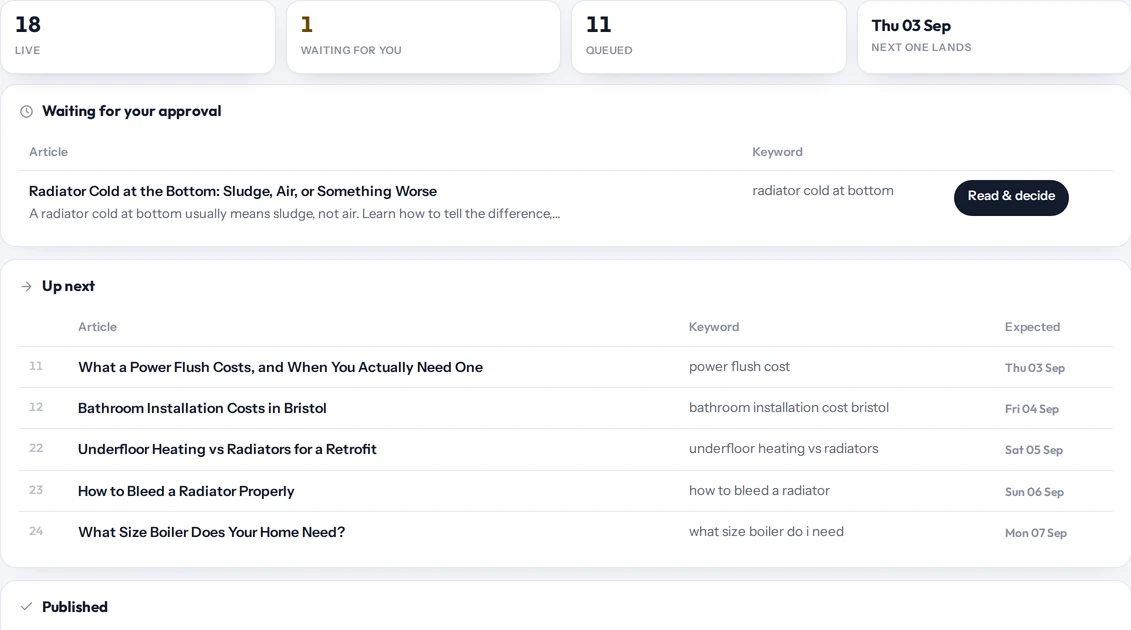
Six weeks in on the demonstration workspace. 18 live, 11 queued, and the next five already dated.
Sign up, point Helio at your website, and approve your first draft this afternoon. 7 days free, no card, from £29 a month, cancel any time.
Keeping your LinkedIn consistent too? Helio Posts turns your team's notes into on-brand LinkedIn posts and holds the cadence. Same Helio, different job.
